
Frequently Asked Questions
Broad Street Traffic Calming and Pedestrian Safety Project
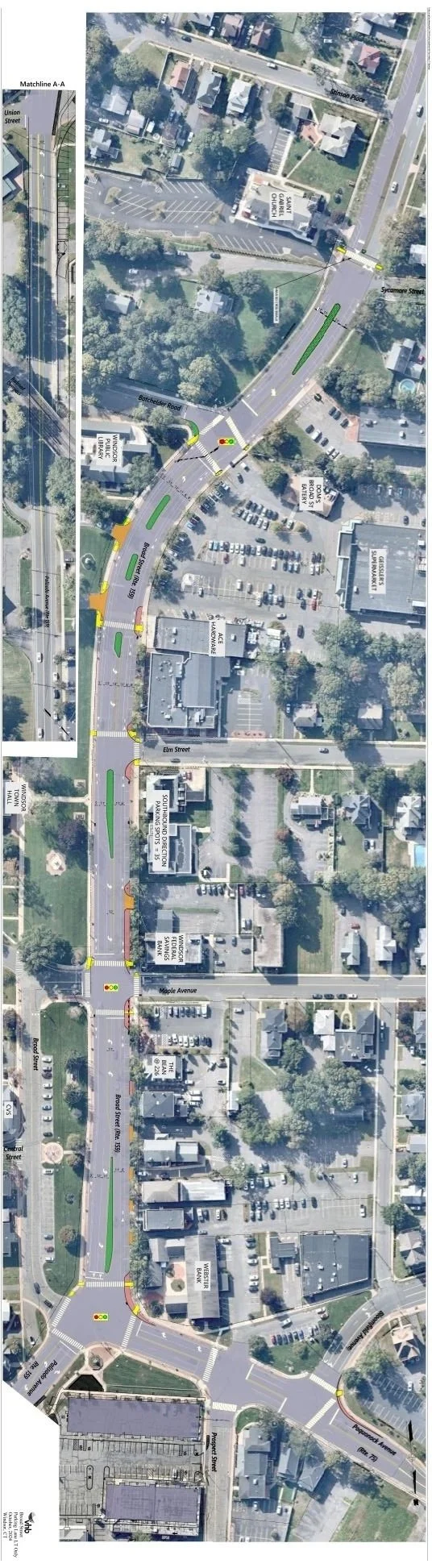
(south at top of image, north at bottom)
-
The Broad Street Traffic Calming and Pedestrian Safety Project proposes to reconfigure Broad Street from four travel lanes to two, with a center turn lane. The redesign also includes dedicated bike lanes and sidewalk bump-outs with shorter crosswalks. The project is the result of decades of advocacy by residents and local business owners, and has been incorporated into Windsor's Transit-Oriented Development Master Plan and Plan of Conservation and Development.
-
A road diet reduces the number of travel lanes on a road, typically from four lanes to two, and repurposes the reclaimed space for other uses — a center turn lane, bike lanes, sidewalk extensions, on-street parking, or greenery. The goal is not to remove capacity, but to reconfigure it so the road serves everyone who uses it: drivers, pedestrians, cyclists, and local businesses.
-
Since 2015, there have been 170 crashes and 16 injuries in the affected project area. This averages out to a crash every 4-5 weeks, and an injury roughly every 8 months.
The crash rate is comparable to other four-lane state roads in Windsor, but a much higher percentage of the injuries are pedestrians. Some of those injuries have been life-altering. -
Windsor’s charter requires different approval processes for projects of different costs, measured against the towns total budget. The original project included two roundabouts and it’s cost exeded the existing funding for the project.
The March 2025 referendum on the full Broad Street project failed, with opposition due to the possible impact on property taxes, concern about roundabouts, and a general sense the that Town Center was changing too fast.
The current iteration of the project addresses the first two issues. The Windsor Center neighborhood supported the project in the referendum. Voters who opposed the original plan due to roundabouts and cost spoke in favor of the current version in public meetings.
Ultimately Broad Street, remains extremely dangerous to all users of the road. Like any project whose costs come in higher than expected, the town government and Council found ways to reduce costs and address residents’ concern while still addressing the underlying safety concern.
-
Road diets help emergency vehicles, not hinder them. Traffic flows more smoothly, and the bike lane provide additional shoulder space for cars to get out of emergency vehicles’ way.
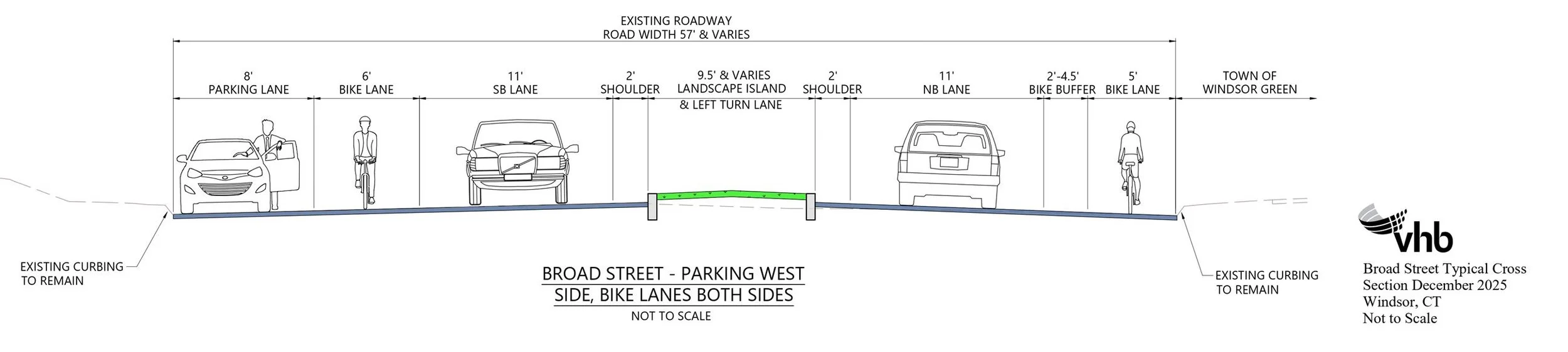
For reference, a fire truck is 8.5’ wide, by state law. As you can see from the diagram at the top of the page, the narrowest point is 19’ and that’s with a parked car’s door open. In other words, there is room for two fire trucks to drive side by side in each direction.
And, of course, slower vehicle speeds also mean fewer severe crashes for emergency services to respond to in the first place. -
No. The project is fully funded. This will not effect property taxes.
-
This is the most common concern and the research consistently shows it doesn't hold up. Four-lane undivided roads with frequent left turns are often less efficient than three-lane roads with a dedicated center turn lane, because left-turning vehicles block through traffic and create unpredictable lane-change conflicts. A properly designed road diet eliminates that problem, allowing traffic to flow more smoothly.
The Federal Highway Administration has found that road diets "reduce overall crashes by 19–47%" while maintaining comparable traffic throughput, because intersections, not mid-block lane count, are the primary constraint on capacity. Most road diets handle rush-hour traffic without incident. Broad Street is no exception: roughly 7 in 10 of its 10,000 daily vehicles are just passing through, and those drivers will continue to pass through; they'll simply do so more safely.
-
It’s hard to imagine this now, but in the run up to the 2025 referendum, the local Republican party was deeply skeptical (though not yet openly hostile) to the project, and the Democratic party did not want to risk politicizing the issue by taking a firm stand. This left a vacuum, as neither the town government or the local non-profits who had be championing the project were allowed to use any funds to urge a specific outcome in the election. In effect, once the referendum was called, there was no one left to speak for the project.
So Keller and Greg started a PAC as a way for residents and businesses to actively support the project.
That’s it. Donations have all been from residents and local business owners. The vast majority have been under $50, and only a few in the hundreds.
-
No, and the evidence points strongly in the opposite direction. Businesses thrive when people feel safe enough to walk, linger, and shop. A Broad Street that moves cars at high speed through town is not good for Windsor Center's retail environment. Most of those 10,000 daily drivers aren't stopping — they're cutting through.
Road diets and pedestrian-friendly streetscapes attract foot traffic, increase dwell time, and raise property values. Hamburg, NY's road diet, completed in 2009, produced a 60% decrease in crashes, a 90% decrease in serious injuries, and — perhaps most notably — catalyzed a wave of social and economic revitalization: a farmers' market, outdoor movie nights, street festivals, and steady population growth. A village trustee called it transformative: "Not a day goes by in my store I don't hear about how everyone loves our village."
Studies from cities across the country show similar results. Businesses near dedicated bike infrastructure see improved economic activity. Safer crossings mean more people on foot, and more people on foot means more customers.
-
This concern is understandable but not supported by the evidence. Road diets reduce conflict points and smooth flow on the main road — they don't divert drivers who are already using that road as a through-route. Side streets typically see reduced cut-through traffic after a road diet, because the calmer main road no longer creates the backups that push drivers to seek shortcuts.