What this is actually about
With all the confusion about Town Council quorums, Special Town Meetings, petitions, etc, I just wanted to take a breath, and remind everyone what the Broad Street Traffic Calming and Pedestrian Safety Project actually is:
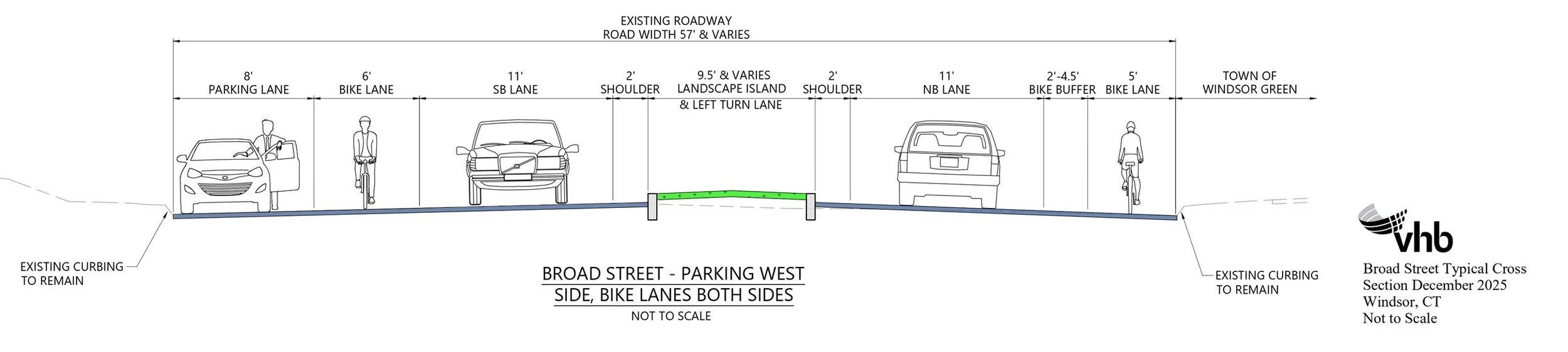
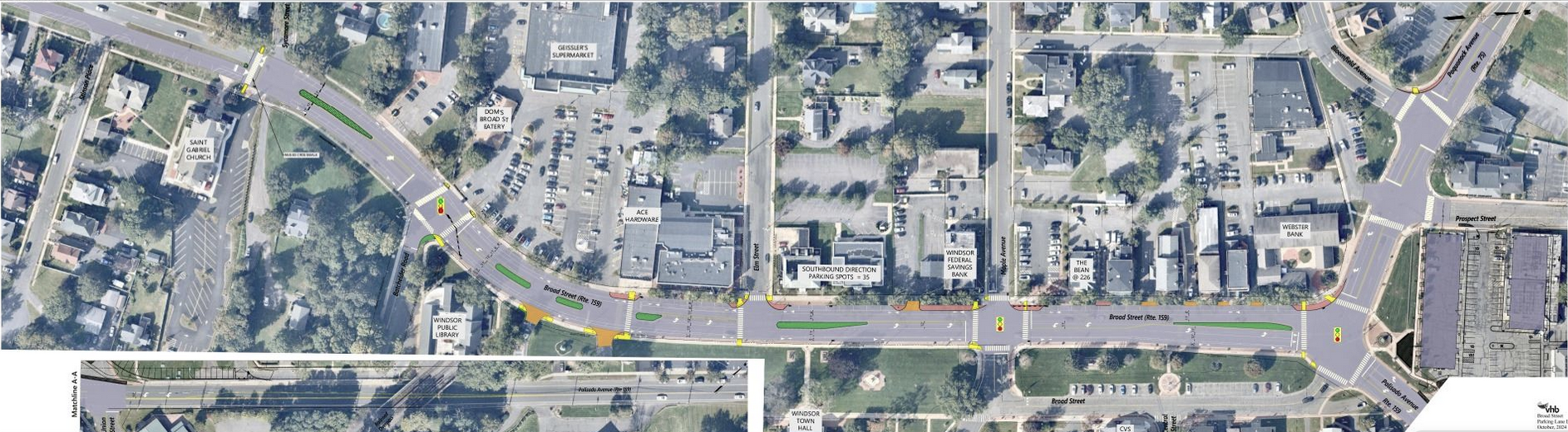
The project: The Broad Street Traffic Calming and Pedestrian Safety Project reconfigures Broad Street (Route 159) through Windsor Center from four travel lanes down to two, with a center turn lane, dedicated bike lanes on both sides, on-street parking on the west side, and shorter crosswalks at the intersections. The goal of road diet lane reductions is to reduce speed, conflict points, and chaotic lane changes, especially in areas with frequent pedestrian crossings. Curb lines and sidewalks are untouched to reduce project costs. The Town Green is untouched.
Local residents, civic organizations, town government, and elected officials at all levels have worked on this project for three decades, from the Town Council Chambers up to Congress. Connecticut DOT has also carefully studied and reviewed the project for years.
No roundabouts. The version that went to referendum in March 2025 included two roundabouts and a $6.1M price tag. That vote failed, and so the roundabouts have been removed from the current proposal, which also lowered the cost significantly. What's retained is the safety core; the lane reduction, the center turn lane, the bike lanes, and the shorter crosswalks.
No impact on your property taxes. The current scope is $2.9M. The town has already secured $1M in state grants, and $3M federal grants which are already in the state comptroller's possession. Windsor taxpayers contribute $0 in property taxes. If we vote yes, the grant funds are used for the project. If we vote no, the state money goes to another town, and the federal money goes back to Washington D.C.
Why this matters:
Broad Street sees just under one crash a month in the area impacted by the road diet.
The Federal Highway Administration has found that reconfigurations like this one reduce crashes by 19–47%.
Broad Street currently carries about 10,000 vehicles daily.
70% of those trips are through traffic, they don't stop in Windsor Center.
30% of drivers exceed the posted 30 mph speed limit.
This design can accommodate up to 20,000 daily trips, at slower speeds, without significant delays.
Hope this is helpful.